
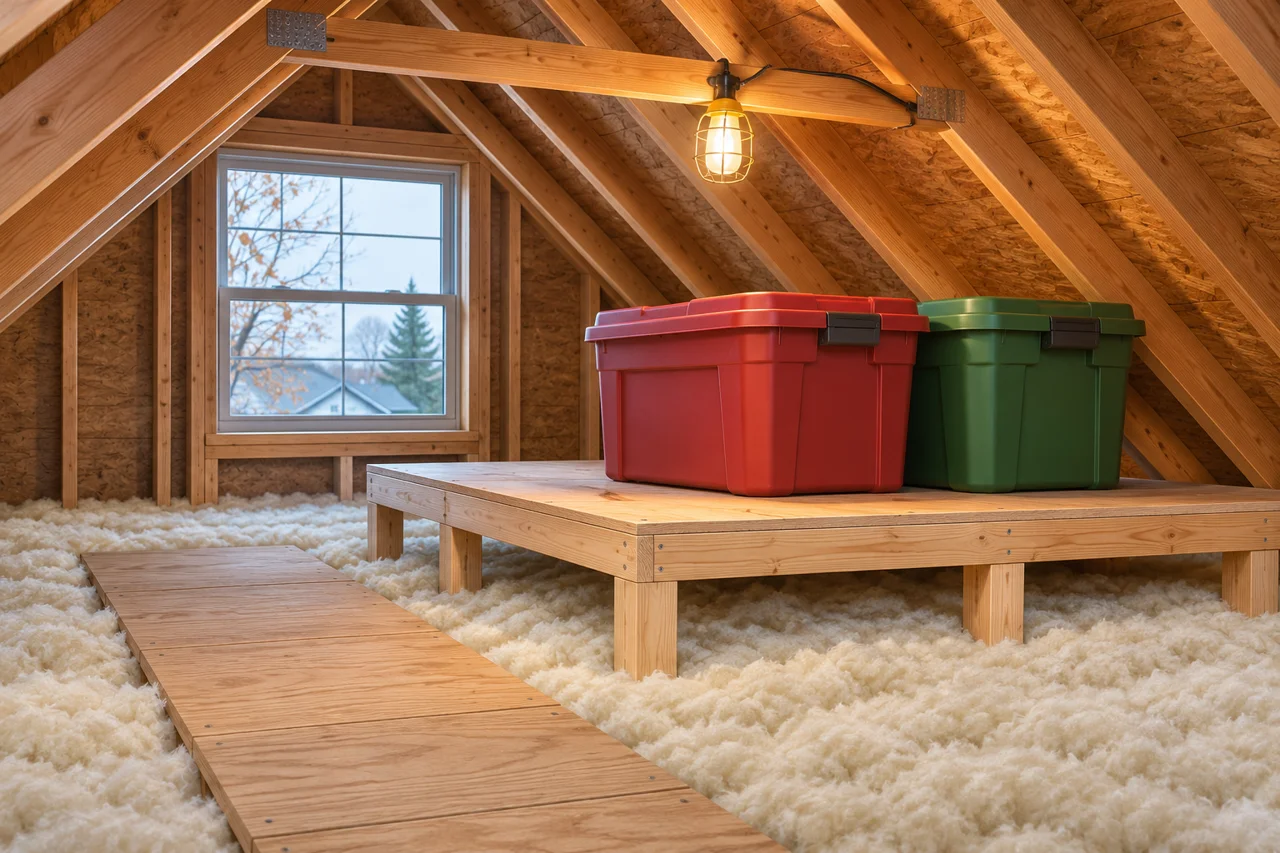
Before bringing holiday boxes down from the attic, check whether storage is flattening insulation or blocking access. In a vented attic insulated at the ceiling, the storage surface and the insulation need separate space. A sheet of plywood resting on insulation is not a complete storage solution, and visible framing does not establish how much weight the attic can carry.
For Fort Wayne and northeast Indiana homeowners, November is a useful time to notice these problems while decorations are being moved. This guide focuses on storage habits and the questions to ask before changing an attic. It does not assume that your attic is designed for storage or that Big Dog Roofing provides structural platform construction.
Start with the kind of attic you actually have
This advice primarily concerns an unfinished, vented attic with insulation across the ceiling below. If insulation follows the roof slope, the attic is finished, or you cannot identify the assembly, ask a home-performance professional before moving insulation or changing ventilation. Different assemblies manage heat and moisture differently.
Look from a secure access point first. Photograph the route to the boxes, the edges of any existing platform, and any insulation displaced beside it. Do not enter an attic without safe access and a known supported walking surface. Ceiling drywall and insulation are not walking surfaces. If reaching a box requires balancing over an open ceiling, choose professional help or another storage location.
Why pressing insulation flat matters
PNNL's guidance for attic platforms calls for room beneath a platform for the full insulation depth, without compression, gaps, or voids. The insulation also needs contact with the air barrier below. Platform height therefore depends on the insulation system; a convenient board height is not automatically adequate.
A useful question for an insulation contractor is: “Can you document what insulation remains under this storage area?” A tidy top surface can conceal an incomplete layer below. Ask for a proposed detail showing the insulation and air-sealing approach before the platform is closed. Have structural suitability assessed separately; adding height does not establish load capacity.
Four things to notice while retrieving decorations
- Boxes sitting directly on insulation. Note their position without dragging them across the attic. Plan a safe way to relocate storage and have the disturbed area assessed.
- A trail of low spots. Repeated trips can leave a path through loose insulation. Photograph it so an insulation professional can distinguish storage disturbance from other conditions.
- Storage pushed toward the eaves. Keep the existing ventilation route visible and unobstructed. Our attic baffle guide explains the separate role of the air passage near the roof edge.
- Boxes obstructing the hatch or equipment access. Leave the access area usable and do not rearrange belongings around equipment without knowing its required clearances.
Do not cut truss members, drill new supports into framing, move wiring, or cover equipment to make a bin fit. For a seasonal storage problem, moving the decorations elsewhere can be simpler than modifying the attic. This is especially worth considering for items you retrieve several times each year.
Stop if you find damp insulation or staining
A storage visit sometimes exposes a problem hidden behind boxes. Wet insulation, deteriorated wood, or damp belongings deserve investigation before anything is covered again. ENERGY STAR's attic insulation project guidance identifies moisture problems, difficult access, inadequate ventilation, and exhaust discharged into the attic as reasons to seek professional help.
Record the location and when you noticed it. Include whether rain had occurred, whether a bathroom fan was operating, and whether the spot seems new or recurring, without assuming the cause. A damp patch alone does not prove the roof covering failed. The distinction between attic condensation and a roof leak helps explain why the right investigation matters.
Do not disturb unfamiliar insulation to trace a stain. ENERGY STAR specifically cautions against disturbing vermiculite that may contain asbestos. If materials or wiring raise concerns, leave the area and have the appropriate professional assess them.
Ask for a plan that separates the trades
Describe the actual goal: occasional holiday storage, a safe equipment route, or a larger storage area. Ask who will assess the framing, who will handle insulation and air sealing, and who will investigate any roof-water entry. Request a scope that identifies each responsibility instead of assuming one contractor covers all three.
For the insulation work, ask how the area below the platform will be inspected and photographed before closure. For the access, ask how the hatch will close without interference; our attic hatch guide covers that separate detail. Keep the proposed storage layout modest enough that future inspections remain possible.
Before you close the attic for winter
Take one final photo from the access point, check that no belongings interfere with the hatch, and keep your notes with the house maintenance records. If you arrange repairs, compare the completed work with the agreed scope and save the photographs. Avoid interpreting this checklist as a promise that an attic will prevent ice dams or eliminate every moisture concern.
If your visit reveals a suspected roof leak, damaged roof penetration, or another roofing concern, contact Big Dog Roofing to discuss a roof repair assessment in Fort Wayne. Describe what you observed and share photos taken safely. Structural storage design, electrical work, and specialized insulation work may require separate qualified professionals.