
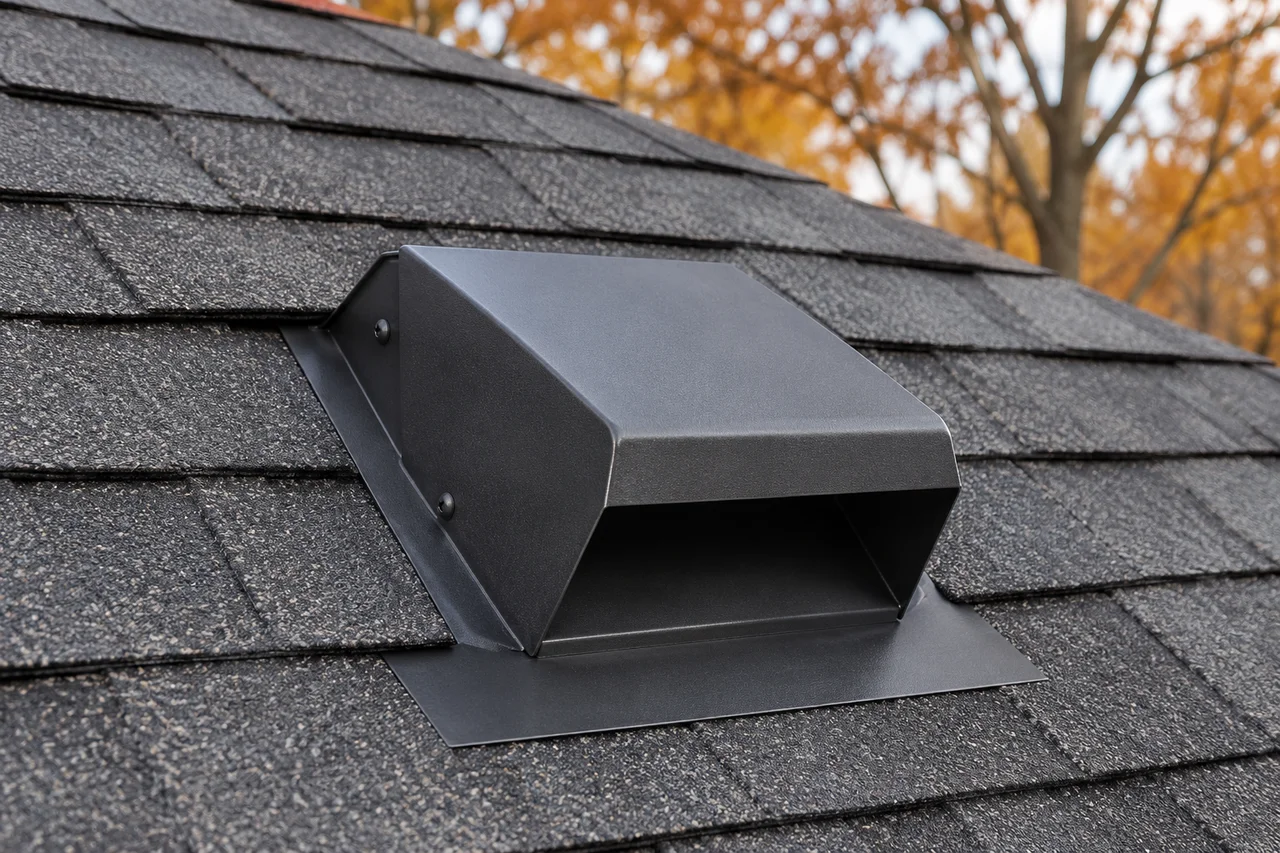
If your clothes dryer exhausts through the roof, a fall check should cover both the exhaust path and the roofing around its cap. A dryer-exhaust specialist evaluates airflow, lint, and duct condition; a roofer evaluates the roof penetration and surrounding shingles. Cleaning one part does not establish that the other is in good condition.
For Fort Wayne homeowners preparing for winter, November is a practical time to identify that hard-to-reach outlet and arrange needed service. This guide applies to ducted dryers, not ventless models. It does not report a current local freeze or snowfall.
Confirm where the dryer actually exhausts
Start with your dryer manual, house records, and previous service reports. Do not assume the nearest roof cap belongs to the laundry room. A home may have separate bathroom exhausts, plumbing vents, attic vents, and a dryer outlet.
The Department of Energy’s roof-vent job aid distinguishes caps by their intended use and calls for household exhaust to terminate outdoors. A cap’s appearance alone does not verify what is connected underneath or whether it is appropriate for dryer exhaust.
If the route is uncertain, ask a qualified professional to trace it and identify the outlet in a photograph. Keep that labeled image with your appliance records. Do not enter an unsafe attic, disconnect concealed ductwork, or climb onto the roof to identify it yourself.
Longer drying times deserve attention
The Consumer Product Safety Commission’s dryer safety alert explains that lint in a dryer or exhaust duct can restrict airflow and contribute to excessive heat and fire. Clothes staying damp after a normal cycle, or taking longer than usual to dry, can indicate a blocked lint filter or exhaust duct.
Clean the appliance’s lint filter before or after each load according to its instructions. A clean filter, however, does not prove that the full duct and rooftop outlet are clear. Arrange evaluation when drying performance changes instead of repeatedly extending cycles and assuming the appliance is simply getting older.
If you notice a burning smell or overheating, stop using the dryer and seek qualified service. For smoke or fire, leave the home and call emergency services. Do not run another load to test whether a suspected hazardous condition has disappeared.
What makes a rooftop outlet a different maintenance problem?
A roof outlet can be difficult to observe or reach safely. That makes a written service plan more useful than an instruction to “check the outside vent.” Tell the service provider in advance that the termination is on the roof and ask whether their visit includes it.
PNNL’s dryer-venting guidance favors short, straight, horizontal exhaust routes and advises avoiding roof termination where practical. It also calls for insulating ducts in unconditioned spaces, especially in cold climates, to limit condensation. An existing roof route therefore deserves assessment; its location alone does not establish that it must be replaced.
Ask the evaluator to compare the actual route with the dryer manufacturer’s requirements and applicable local requirements. Length, bends, materials, access, and termination all matter. Do not use a generic internet length limit as a substitute for identifying the installed appliance and duct layout.
Keep the exhaust inspection separate from the roof inspection
When booking service, describe the symptom first: slow drying, lint visible near an outlet, a damaged cap, or an indoor water stain. Then agree on who will inspect each part.
- Dryer and exhaust path: ask an appliance or dryer-exhaust specialist about the appliance connection, duct condition, cleaning access, outlet operation, and verification after service.
- Roof opening: ask a roofer about the cap’s flashing, surrounding shingles, and evidence of water entry or damage at the penetration.
- Uncertain moisture source: request findings before approving a repair. An indoor stain near the route does not, by itself, prove that the roof cap leaks.
A roofing repair should not be described as a complete dryer-duct cleaning unless that work was actually included. Likewise, a cleaning receipt does not certify the flashing. Our condensation-versus-roof-leak guide explains why moisture diagnosis sometimes needs more than an exterior look.
Do not add a generic screen over a dryer outlet
A screen can seem like an easy way to keep pests or leaves out, but dryer exhaust needs a termination suited to lint-bearing air. PNNL’s guide specifies a damper and no screen at the exhaust termination. Have a qualified professional identify the correct cap and follow its instructions rather than adapting a bathroom or attic vent by appearance.
If a cover looks damaged or an opening appears exposed, photograph it from the ground if possible and arrange service. Do not seal the outlet, improvise a mesh cover, or treat an unknown roof opening as an unused vent. The illustration on this page is conceptual, not a product-selection or installation specification.
Ask for a useful closeout record
Before the appointment, write down the dryer model, the symptoms, and the date of the last known cleaning. Afterward, request a concise record answering these questions:
- Which outlet serves the dryer, and what route was confirmed?
- Which portions were inspected and cleaned, and were any inaccessible?
- What condition was found at the roof cap and surrounding roof?
- How was operation checked after the work?
- What follow-up remains, who handles it, and when should maintenance recur?
CPSC recommends periodic vent and duct cleaning and qualified service for lint inside the dryer chassis. Use the appliance instructions and the provider’s findings to establish your maintenance schedule. Keep the report so a future roofer or exhaust specialist can see what was actually checked.
Arrange roofing help for a damaged cap or suspected leak
Big Dog Roofing provides roof repairs in Fort Wayne and surrounding northeast Indiana communities. If a rooftop cap is damaged or you suspect water entry around a roof penetration, contact Big Dog Roofing with ground-level photographs and the location of the concern. Arrange dryer or duct service with a qualified provider for airflow and cleaning issues.