
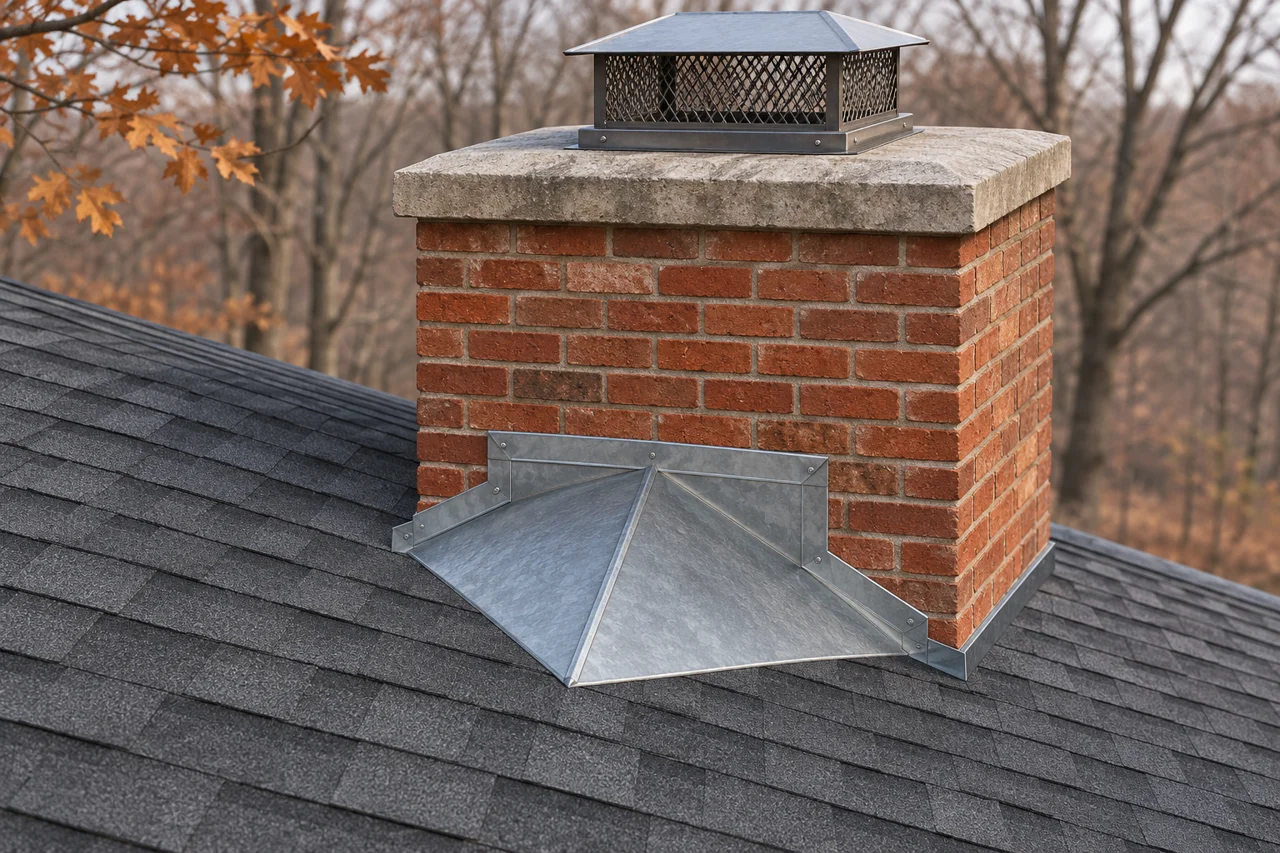
A chimney cricket is a small raised roof section on the uphill side of a chimney that redirects runoff around it. If leaves repeatedly collect behind your chimney or an inspection has raised a drainage concern there, ask the roofer to assess that specific intersection before winter. The answer may involve maintenance, flashing repair, or a different drainage detail; a photograph alone cannot establish the right scope.
November is a useful time for Fort Wayne homeowners to discuss this often-hidden part of the roof. This guide focuses on what a cricket does and how to evaluate a proposal. It does not assume your chimney needs a new cricket, and it is not an installation plan or a report of current local weather.
Where the cricket sits and what it changes
Imagine rain moving down the roof toward the back of a chimney. The chimney interrupts that path. A cricket, sometimes called a saddle, creates sloped surfaces that send the water around the obstruction. GAF's explanation of roof crickets describes their uphill location, water-diversion role, and ability to reduce debris accumulation.
The cricket is not the chimney cap at the top, and it is not simply a bead of sealant along the brick. On a steep roof, its covering may be metal or roofing material. Do not judge whether one exists solely from the front of the house: the uphill face may be concealed by the chimney itself.
The flashing still matters
A raised shape does not by itself complete the water-control system. The Building America Solution Center's chimney guidance explains that the roof and chimney water-control layers must connect, with flashing arranged to shed water. It describes a cricket or saddle redirecting runoff around the upper side of a brick chimney.
Ask the contractor to explain where water will go after it leaves each side of the cricket and how the surrounding roofing and flashing connect. A proposal should address those transitions, not merely name a new piece of metal. Our broader chimney-leak repair guide covers other possible sources of water entry around a chimney.
What you can document without going onto the roof
From a safe ground-level location, note anything you can actually see: recurring leaf buildup, visibly displaced metal, or an area that looks different from earlier photographs. If the back of the chimney is hidden, say that it is not visible rather than guessing. Do not use a ladder to obtain a better photograph or reach behind the chimney with a tool.
Inside the house, record any new stain and the date it was noticed. Include whether it seems to recur with rain or another condition, and share prior repair paperwork. A stain near a fireplace is a reason for investigation, not proof that the cricket is missing or defective. Keep notes about what happened separate from your theory about the cause.
If debris is the main concern, ask for safe professional removal and photographs of the area afterward. Clearing leaves may reveal a detail that could not be evaluated while covered. It does not establish that all underlying materials are sound. The related roof-valley leaf guide explains another place where runoff and autumn debris meet.
Questions that make an assessment useful
- What is there now? Request an overall photograph showing the uphill intersection and close views of the relevant flashing, with the locations explained.
- What is the observed defect? Ask the roofer to distinguish debris, damaged roofing, an existing flashing problem, and a proposed drainage improvement.
- Is a cricket appropriate for this roof? Have the contractor consider the chimney geometry, roof slope, materials, and applicable requirements rather than copying another house.
- What will be opened or replaced? Clarify whether the proposal includes surrounding shingles, underlayment, metalwork, or evaluation of concealed decking.
- Who handles masonry concerns? Identify whether another qualified professional is needed and how the work will be coordinated.
You do not need to measure the chimney from the roof yourself. Ask the contractor to document the dimensions and the basis for the recommendation. This article does not determine local code compliance or provide a universal size threshold for your home.
Keep roofing, masonry, and fireplace work distinct
A roof-intersection assessment should not be mistaken for a complete inspection of the fireplace, flue, chimney crown, or chimney structure. Explain any concerns you have about those areas separately, and ask who is qualified to evaluate them. A roofing repair does not certify that a fireplace is ready to use.
If both masonry and roofing work are proposed, request a written sequence and a clear responsibility for the final flashing connection. Before approving a scope, make sure it explains which contractor handles each part and who will provide completed-work photographs. This is particularly helpful when an earlier patch has not resolved the symptom.
Plan the work and the follow-up before winter
Ask what conditions are needed for safe access and proper installation, and what happens if the planned workday is unsuitable. If active water entry requires temporary protection first, have the proposal identify the permanent follow-up. Our cold-weather sealant guide explains why temporary protection and a completed repair should be documented separately.
After the work, save photographs showing the overall cricket and both runoff paths, along with the invoice and any remaining recommendations. Ask how future debris checks should be handled safely. A clean-looking metal surface is useful documentation, but it is not a guarantee against every possible chimney leak.
For a concern where your chimney meets the roof in Fort Wayne or northeast Indiana, contact Big Dog Roofing to discuss a roof repair assessment. Share the visible symptoms and any previous repair history so the next step can address the actual roofing condition.