
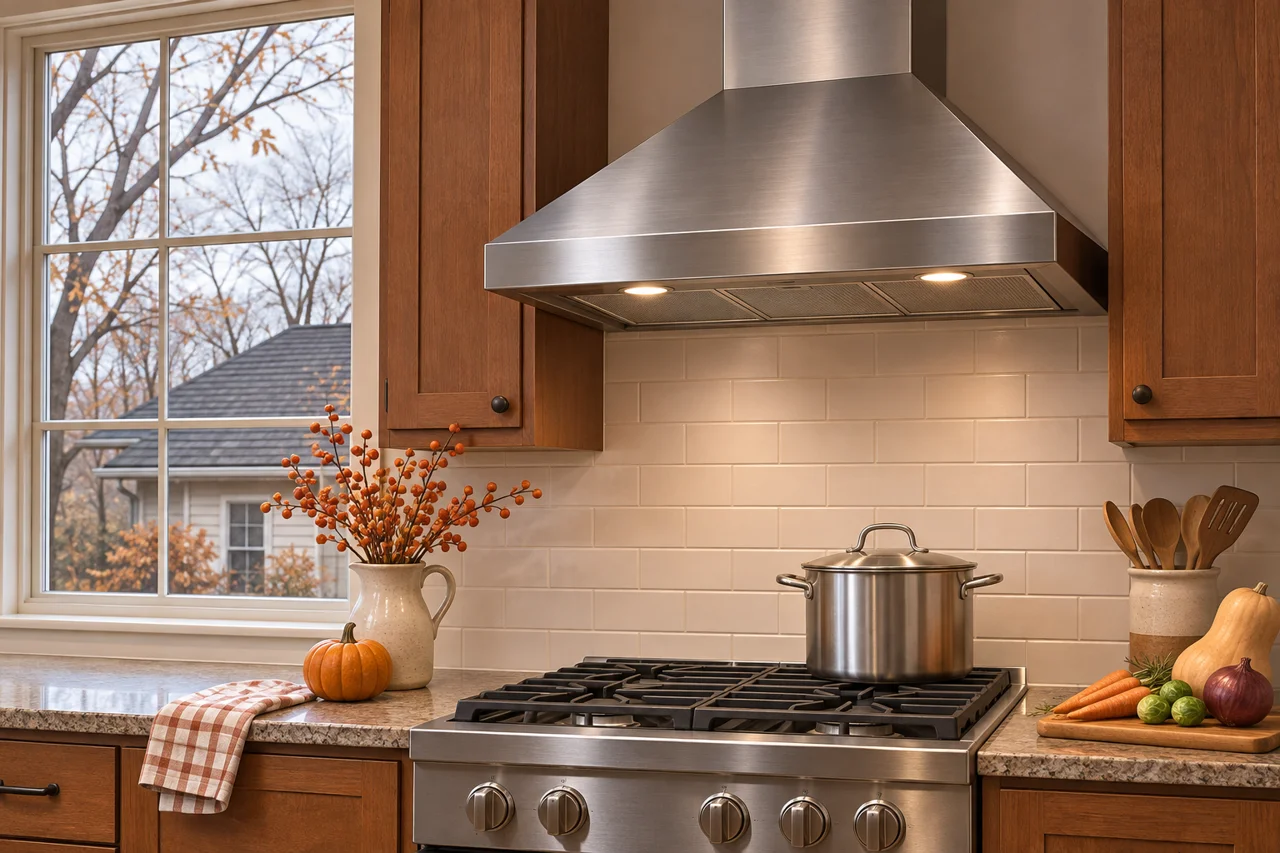
A running range hood does not necessarily mean cooking moisture is leaving the house. Some hoods recirculate air into the kitchen; others use a duct that should reach an outdoor termination. If that route passes through the attic and roof, both the duct connection and the roof penetration deserve attention.
With holiday cooking approaching, November is a practical time for Fort Wayne homeowners to find out which arrangement they have. This guide focuses on identifying the exhaust route and arranging the right assessment. It is not a recommendation to enter an unsafe attic, climb onto the roof, or convert an appliance yourself.
First, identify recirculation versus outdoor exhaust
Start with the hood or over-the-range microwave model number and installation manual. Look for the documented ventilation configuration and any records from a kitchen remodel. Some appliances support more than one configuration, so the model's capabilities do not by themselves establish how yours was installed.
The Building America Solution Center's kitchen exhaust guide distinguishes recirculating fans from systems ducted outdoors. Its retrofit guidance calls for a suitable fan, manufacturer-recommended duct sizing, a direct route, an appropriate exterior termination, and confirmed airflow. Those are connected design choices, not simply a matter of finding an unused roof vent.
If you cannot determine the configuration from accessible information, ask an HVAC or qualified ventilation contractor to trace it. Do not remove electrical covers or dismantle the appliance to find the answer. A loud motor, a decorative chimney cover above the hood, or a vent visible somewhere on the roof is not enough to confirm the full route.
An attic vent is not the end of the kitchen duct
A kitchen duct pointed toward an attic ventilation opening can still discharge into the attic. PNNL's guide to exhaust fans venting outside explains that moisture released there can condense on cold framing and sheathing and contribute to damage. The exterior connection needs to be evaluated, not inferred from the direction the duct faces.
Ask the contractor to document the connection from the appliance to the outdoor outlet. If the kitchen hood was replaced during a remodel, mention when that happened and whether the existing duct was reused. That history may help the assessor decide where to look; it does not establish that the previous work caused a problem.
Keep ordinary attic ventilation separate from appliance exhaust. Our winter attic vent guide discusses the roof's ventilation openings. Adding more general attic vents is not a substitute for completing a kitchen exhaust route to the outdoors.
Roof outlet or wall outlet: do not assume the route
A roof termination is one possible arrangement, but an exterior wall outlet may be appropriate for a different kitchen layout. Before anyone proposes a new hole in the roof, ask why that route was selected and how it fits the appliance instructions and the house. A ventilation contractor should address the system design; roofing work should address the weather-resistant roof connection when a roof outlet is involved.
If a roof cap already exists, have its identity and suitability confirmed. Similar-looking caps can serve different purposes. Do not connect the kitchen to a convenient-looking duct or combine it with another appliance's exhaust without a qualified design review. This guide does not specify a universal cap, duct diameter, fan capacity, or local code determination.
Match the symptom to the first call
- The fan runs, but the exhaust route is unknown. Start with a ventilation or HVAC assessment to establish the configuration and performance.
- The appliance controls, motor, or lights malfunction. An appliance service professional may be the appropriate first contact; explain the exact behavior and model.
- A duct is visibly disconnected or ends inside the attic. Arrange qualified duct-system correction and assessment of any affected materials. Do not treat a roof repair alone as completion of that work.
- The roof cap looks displaced or water entry seems associated with the penetration. Discuss a roofing assessment, while keeping duct and appliance questions in the scope of the appropriate trade.
- There is dampness or staining without an established cause. Report when and where it occurs. Ask for investigation rather than assuming cooking moisture or a roof leak is responsible.
These are starting points for coordination, not diagnoses. In particular, a stain near the kitchen ceiling does not prove the roof cap leaks. Our attic condensation versus roof leak guide explains why observations and timing matter.
A stronger replacement fan is not a complete plan
If a new hood is proposed, ask how the existing duct and exterior termination will be checked for compatibility. PNNL's kitchen retrofit guidance treats airflow verification and make-up air as part of the planning process. Have the ventilation professional evaluate the house and applicable requirements rather than choosing a fan only by the largest advertised airflow number.
Also ask what user maintenance the appliance manufacturer requires and obtain the correct filter-care instructions. Keep model numbers and service records together. Do not use a flame, smoke source, or improvised roof-access test to judge whether the exhaust works. A professional assessment can address performance without making a holiday meal the test event.
Close the loop between the trades
For work involving a roof outlet, the written scope should identify who handles the appliance and duct, who handles the roof cap and flashing, and who confirms operation afterward. Request photographs of the completed connections and a description of any remaining limitations. If a ceiling or attic area was already damp, ask who will evaluate that condition before it is covered again.
Big Dog Roofing can discuss roof repair concerns around a kitchen exhaust penetration in Fort Wayne or northeast Indiana. Contact Big Dog Roofing with the observed roof symptoms and any available photos. Kitchen appliance repair, duct design, airflow testing, and electrical work may require separate qualified professionals; confirm that division of work before scheduling.