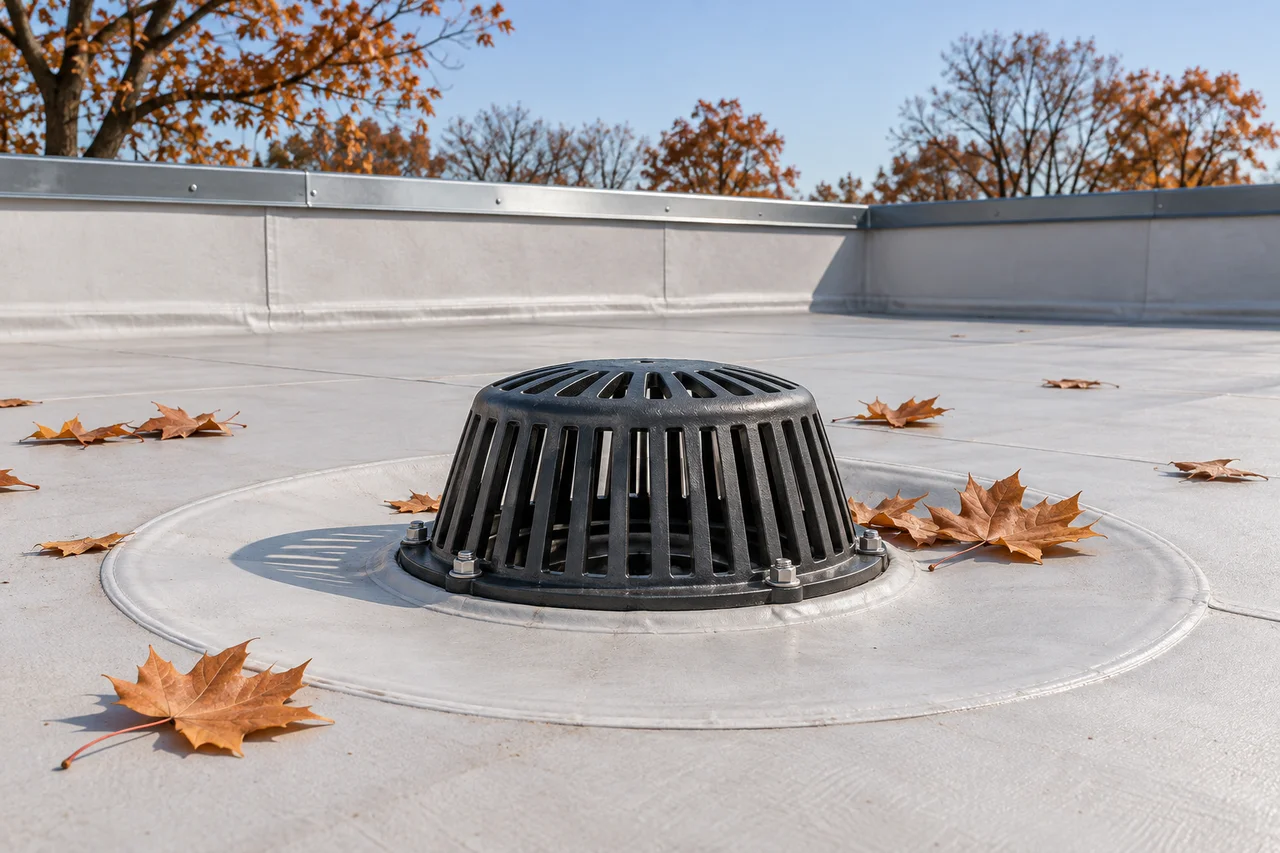
Before winter, have your commercial roof's drains, scuppers, and discharge paths checked for debris and proper drainage. A roof can look tidy from the parking lot while leaves collect around an outlet above. For a Fort Wayne building owner or property manager, a useful fall visit should identify each drainage point, document its condition, and assign any follow-up work.
This November checklist focuses on drainage on flat and low-slope roofs. For a broader inspection plan covering the roof surface, flashings, and rooftop equipment, see our commercial roof maintenance guide.
Know where water is supposed to leave the roof
Ask the inspector to identify the roof's drainage arrangement. Some buildings have drains connected to interior piping; others discharge through openings at the roof edge, often called scuppers, or through gutters and downspouts. A building with additions may have more than one arrangement.
A facilities-management article published by IFMA explains that roof drains collect water and send it through piping, and recommends checking strainers and pipe connections as part of routine maintenance. Its preventive drain maintenance guidance also recommends coordinating this work with roof inspections.
Use a simple roof plan or annotated photograph to label the outlets. Names such as “rear warehouse drain” and “east office scupper” are more useful in a work order than “the drain.” Ask the inspector to identify any secondary overflow provisions separately so everyone understands which opening is being discussed.
Why leaves deserve attention in fall
Carlisle's fall drainage maintenance guidance describes how debris around drain baskets, scuppers, and gutters can restrict water leaving a roof. It recommends checking for ponding, documenting findings, and considering another visit after most leaves have fallen.
A cleaning performed earlier in the season is a completed task, not proof that the outlets are still clear today. Check the date of the last visit and ask whether the surrounding trees justify another inspection. Let actual roof conditions guide the next appointment rather than assuming one annual date suits every property.
What to request in the inspection report
Ask for a short record for each outlet instead of a single statement that the roof was cleaned:
- Location: the outlet's label on the roof plan and an overview photograph.
- Condition before work: visible debris, damaged or missing components, and any water remaining nearby.
- Work completed: what was cleared or repaired and by whom.
- Condition afterward: a photograph and an explanation of how drainage was assessed.
- Unresolved findings: the affected location, recommended specialist, responsible person, and next checkpoint.
For example, a hypothetical report might say that leaves were removed from the rear drain basket but drainage still appeared restricted. That is a useful finding only if it leads to an assigned investigation. It should not disappear beneath a “cleaning complete” label.
A clear opening does not settle every drainage concern
Visible debris is one thing an inspection can find. If water remains after cleaning, ask what additional assessment is needed rather than assuming more sweeping will solve the issue. The roof surface, drain assembly, and connected piping may require different expertise. Have the contractor explain which part has been checked and which part remains uncertain.
IFMA's drainage guidance discusses both rooftop strainers and piping connections. This is why the person responsible for the building should confirm whether a roofing visit includes only the roof-side components or also investigation of the drainage piping. Do not assume plumbing work is included in a general roof maintenance price.
Record when the water was observed and the relevant rain timing. A photograph without a date or context is harder to interpret. Ask the roofing professional to evaluate the observation against the installed system's requirements; do not use a generic online time limit as proof that your roof is satisfactory.
Protect the roof during access and cleaning
Keep roof access with personnel equipped and authorized for that building. Do not send an employee onto an unfamiliar roof simply to take a picture. Arrange access details, applicable fall protection, and the areas to be inspected with the contractor before the visit.
Carlisle's roof maintenance guidance advises checking drain strainers for damage or absence. It also cautions against aggressively breaking drain ice with tools because this can damage the membrane. Those are useful points to include in the winter maintenance handoff.
If ice later develops, arrange an assessment suited to the roof system rather than improvising with sharp tools or an unspecified chemical. If water is entering the building or a drainage problem is getting worse, report the condition promptly and follow the building's safety procedures.
Make the maintenance handoff easy to follow
Keep the roof plan, report, photographs, and service invoice in one location available to the property manager. Add the installing contractor's information and the roof system documentation if available. For a leased or multi-tenant building, identify who receives roof concerns and who can authorize work.
A good closing email can be brief: “These outlets were checked, these tasks are complete, this issue needs further assessment, and this person owns the next step.” If repairs are recommended, request a scope that identifies the location and explains how completion will be documented.
Review any manufacturer notice requirements in the actual roof paperwork before repair work begins. A maintenance article cannot determine coverage for a particular roof, and an inspection alone does not establish a warranty outcome.
Arrange a commercial roof assessment in Fort Wayne
Big Dog Roofing can discuss your building's roof concerns and the appropriate commercial roofing assessment. Explain whether the issue involves visible debris, persistent water, a damaged outlet, or an interior leak, and confirm which drainage components are included in the proposed work.
Contact Big Dog Roofing or call 260.999.0347. Have the property address, access requirements, prior maintenance date, and any photographs ready so the visit can focus on the areas that need attention.