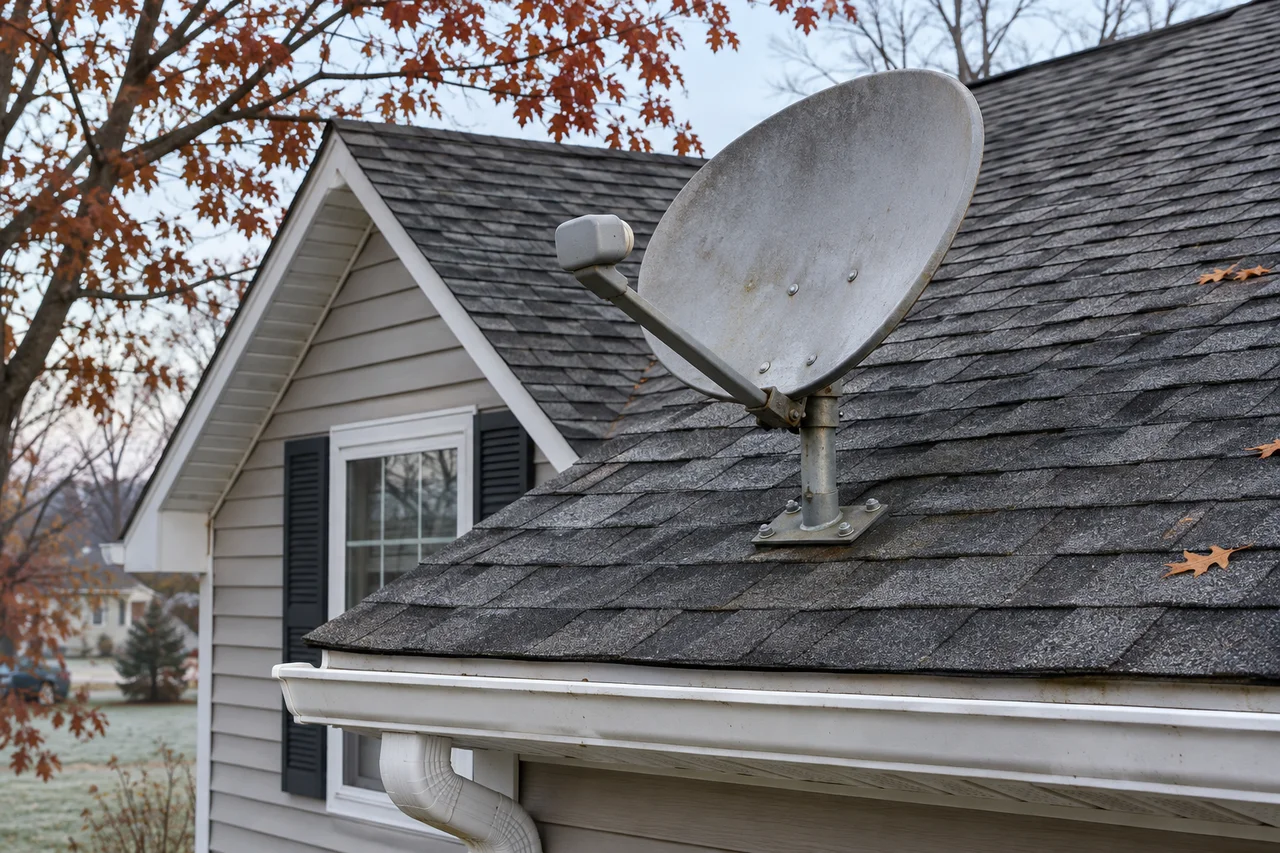
Before removing an unused satellite dish from your roof, arrange both the equipment removal and the repair of the mounting area. Taking away the dish does not necessarily remove the mounting foot, restore damaged shingles, or address the fastener openings beneath it. Those details should be part of the plan before anyone starts loosening hardware.
For a Fort Wayne homeowner making a November maintenance list, an old rooftop dish is worth discussing during an inspection. Its presence alone does not prove a leak or make removal an emergency. The useful question is whether the attachment is sound and, if you want it removed, how the roof will be left afterward.
Confirm the equipment is actually unused
Start with the household and service records. Identify whether the dish still serves a receiver, whether anyone expects to keep using it, and whether a provider needs to be involved. If the equipment came with the house, say that its history is unknown rather than assuming it is abandoned.
Ask the provider about any account-specific equipment requirements and which components, if any, must be returned. Do not assume that canceling service includes rooftop removal or roof repair. Likewise, a quote for hauling away the dish should not be treated as a roofing scope unless it explicitly includes that work.
Have unfamiliar cables identified before they are disconnected. A roof visit is not a reason to cut every wire near the mount. Tell the contractor about any active equipment or cables you want preserved.
Separate the dish, the mount, and the roof repair
A practical estimate should describe three things separately:
- Equipment: which dish, mast, brackets, and cables will be removed or retained.
- Attachment: whether the roof-mounted foot and its fasteners will remain, and why.
- Roof restoration: what will be inspected and repaired where the equipment was attached.
Ask for a photograph showing the exact mounting location. A dish near the roofline might be attached to a wall or fascia instead of through shingles, so the repair plan should follow the actual attachment. If the mount is on siding or trim, identify who will restore that surface as well.
GAF's roofing project checklist recommends scheduling satellite-dish removal and replacement in advance so service providers can coordinate with roof work. That coordination is useful for a small repair too: avoid a gap where one contractor has removed equipment and another has not yet addressed the roof.
Do not assume a dab of caulk is the complete repair
After removal, the roofer should assess the affected shingles, the attachment openings, and any accessible underlying damage. Ask which materials need repair or replacement and which manufacturer's instructions guide the work. A broad description such as “remove dish and seal holes” leaves important questions unanswered.
For a related example, GAF's bulletin on exposed nails in shingles calls for replacement of face-nailed shingles and does not consider coating those exposed nails with cement or caulk a permanent repair. That bulletin addresses exposed roofing nails, not every possible satellite mount, but it illustrates why a surface coating should not automatically be accepted as the finished solution.
The appropriate repair depends on what is uncovered. If the contractor recommends replacing a small shingle area, ask about matching the existing material and the expected appearance. Our guide to matching shingles for repairs explains what to discuss when the original product is no longer available.
Plan the work around safe conditions
Do not climb onto the roof to loosen the dish or test the mount. The Asphalt Roofing Manufacturers Association warns that cold-weather roof work can involve difficult-to-see frost or ice, and that cold shingles are less flexible and can be damaged by handling or foot traffic. See its cold-weather roofing guidance.
For a November appointment, ask the contractor how access and the roofing materials will be evaluated before work starts. If conditions require postponement, confirm the new checkpoint and whether any existing damage needs temporary attention. A calendar deadline should not turn an optional removal into rushed roof work.
If you can see loose equipment, displaced shingles, or active water entry, report that condition promptly and keep clear of the area below unstable equipment. Let the professional determine how to secure it and assess the roof.
Use a short written scope to prevent missed work
Before agreeing to the job, ask the contractor to confirm:
- The equipment and mounting components included in removal.
- Who handles service disconnection, cable routing, and disposal.
- How the mounting area will be assessed after removal.
- The proposed roofing repair and how newly discovered damage will be documented before extra work is approved.
- Whether any hardware or cables will remain, with their locations and the reason.
- What completion photographs and follow-up information you will receive.
As a hypothetical example, a removal company might quote only the dish and mast while leaving the foot attached. A roofer might quote full attachment removal and shingle replacement. Those are different scopes, so compare what each leaves on the house before comparing the totals.
Check the result without walking the roof
Request photographs of the original mount, the area exposed during work, and the completed repair. Ask for a written description of anything left in place. Save the images and invoice with the rest of your roof records so a future inspector can understand what changed.
If an interior stain or leak was part of the concern, keep its location and observation dates in the record. The dish's location alone does not establish where water entered. Our roof leak source guide explains why the visible stain may not line up with the entry point.
Ask about the roof before arranging removal
Big Dog Roofing can assess the roofing around an old attachment and discuss an appropriate roof repair scope. Confirm removal and provider coordination arrangements for your particular equipment rather than assuming they are included.
For a Fort Wayne home, request a free 21-point inspection or call 260.999.0347. Mention that you are considering satellite-dish removal and whether you have noticed any looseness, missing material, or water entry.