
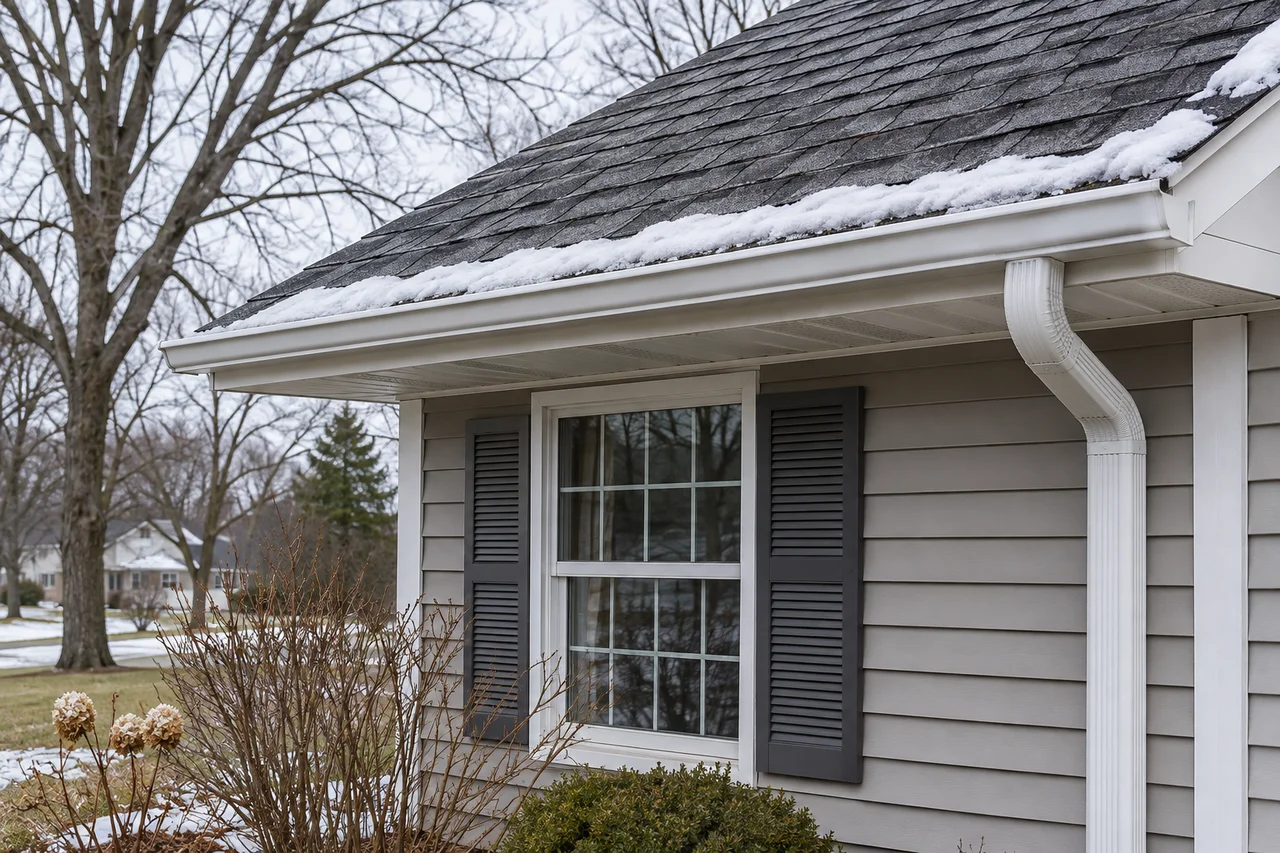
Do not assume the ice melt you use on a driveway is suitable for your roof or gutters. Before applying a chemical deicer, verify the exact formulation and its compatibility with the roofing, gutter materials, and other surfaces the runoff will contact. A product's ability to melt ice does not answer those questions.
For Fort Wayne homeowners stocking winter supplies in late November, this is a useful distinction to make before an icy roof edge creates pressure to act quickly. This article addresses product selection and roof-system compatibility; it does not report current local ice or snow conditions.
Why isn't there a simple yes-or-no answer about salt?
Even a single roofing manufacturer's published guidance shows why broad claims can mislead. IKO's contractor FAQ says asphalt shingles are essentially unaffected by salt and ice-melting granules, while cautioning about residue, gutter materials, and vegetation downstream. Its ice-dam removal article advises against ice-melt tablets on asphalt roofs and warns that some formulations can affect shingles.
Those statements are not a dependable approval for an unidentified bag of deicer on an unidentified roof. Ask the roofing manufacturer about the specific product, exposure, and roof materials involved. Avoid both extremes: assuming every salt instantly ruins shingles, or assuming every ice-melt blend is harmless.
A recommendation for an asphalt-shingle surface also does not automatically cover a metal roof, a membrane porch roof, a painted gutter, or a skylight component. If your home has more than one roofing material, identify each area that could receive the product or runoff.
What should you check on the container?
Start with the full product name and the actual label, not a shelf description or an abbreviated online listing. Save a clear photograph of the front and the directions so the manufacturer or contractor can review the same information you are seeing.
- Intended surfaces: Does the manufacturer explicitly address roofs, or does the label discuss only pavement and walkways?
- Ingredients: Is it a single compound or a blend? Do not substitute one product for another merely because their packages use similar wording.
- Restrictions: Look for exclusions involving metals, coatings, plants, or particular surfaces. Ask for clarification when the relevant material is not mentioned.
- Application and cleanup: Are the specified conditions and methods feasible for this roof without unsafe access?
- Supporting instructions: Obtain the current product directions and, where available, the safety data sheet. Neither a marketing claim nor a safety sheet alone establishes roof compatibility.
Terms such as “pet friendly” or “concrete safe” answer different questions from whether a product belongs on a roof. If roof use is unclear, leave that question unresolved until the relevant manufacturer confirms it. Do not improvise a concentration or placement method to fill a gap in the instructions.
Why do gutters and landscaping matter?
A roof treatment does not remain only where it is placed. Follow the drainage route in your planning: roof edge, gutter, downspout, outlet, and the area beyond it. Note whether water discharges near a planting bed, walkway, driveway, or neighboring surface.
University of Minnesota Extension explains that deicing salts can harm plants and aquatic life, and that runoff carries these chemicals beyond the application area. Its landscape guidance is another reason to consider where meltwater goes rather than evaluating only the shingles.
Ask about your gutter's material and finish instead of describing it simply as “metal.” A response about one material is not necessarily a response about all the components in your drainage system. For the broader drainage question, see our downspout drainage guide.
Are roof tablets or filled socks automatically safer?
No product format supplies blanket approval. A tablet, granule, or fabric container still has a particular chemical formulation and a particular contact pattern. A method shown in a short video may omit the roof material, product restrictions, or what happened afterward.
Rather than copying the demonstration, ask what specific problem the proposed treatment is meant to solve. Is the concern active water entry, a blocked drainage path, or simply visible ice? The appropriate response should follow the conditions at your home. Do not climb onto an icy roof or lean a ladder against an ice-laden gutter to place a product.
What if you have already applied ice melt?
Keep the packaging and record approximately how much you used, when, and where. Tell the roofing professional whether it went on shingles, into a gutter, or onto another surface. Photographs taken safely from the ground can help identify the area.
Do not add a second chemical, pressure-wash the roof, or chip away ice in an attempt to undo the first application. Ask the product and roofing manufacturers about appropriate next steps for the identified materials. Residue by itself does not establish structural damage; equally, the absence of an obvious stain does not confirm compatibility.
If an inspection is limited by snow or ice, request a follow-up for concealed areas. Our guide to snow-covered roof inspections explains what a winter visit can and cannot establish.
Melting ice is different from preventing its return
IKO's ice-dam guidance treats removal as temporary and emphasizes investigating why the ice formed. A product purchase should not replace that investigation when the same roof edge repeatedly has trouble. Ask which conditions need assessment and which corrective work, if any, is supported by the findings.
For background, read our Fort Wayne ice-dam guide. Heat cables are another separate decision; they require their own product and installation review, as discussed in our roof heat-cable guide.
Get help with the roof concern before adding chemicals
If water is entering your home, request prompt professional help instead of waiting to compare deicer products. Keep people away from falling ice, a sagging wet ceiling, or water near electrical equipment.
Contact Big Dog Roofing to discuss a roof or gutter concern at your Fort Wayne-area home. Share the location, visible conditions, and any product already used. Ask about an inspection and roof repair; confirm separately whether a particular ice-removal service is available and appropriate.
Sources
- IKO: Contractors' Frequently Asked Questions — question 19 discusses salt, residue, and downstream materials.
- IKO: Roof Ice Dam Removal — cautions about ice-melt formulations and temporary removal methods.
- University of Minnesota Extension: The Effects of Deicing Salts on Landscapes — runoff and vegetation considerations.