
Standing-seam metal is the premium residential choice when you want concealed fasteners, clean lines, and a system built to manage thermal movement. Exposed-fastener panels can be a good value on simple roofs, outbuildings, porches, and budget-sensitive projects when the screws, washers, laps, and maintenance plan are taken seriously. One is not automatically honest and the other cheap junk.
The price gap comes from more than panel thickness. It includes clips, seams, forming, trim, labor, roof geometry, and installer skill. Compare complete systems and written details through our Fort Wayne metal roofing service, not a per-panel number.
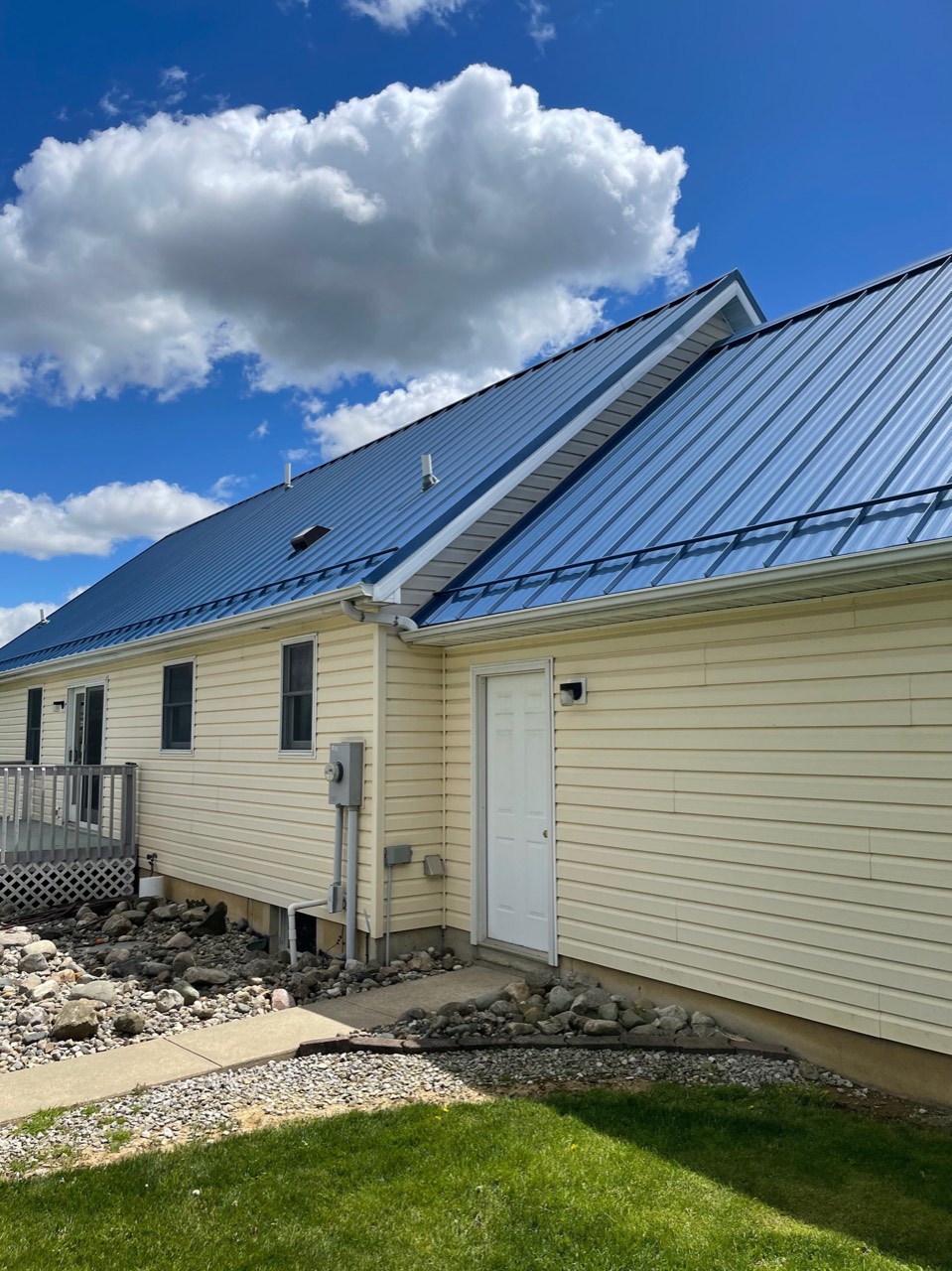
| Feature | Standing seam | Exposed fastener |
|---|---|---|
| Fasteners | Concealed clips or attachment below raised seams | Screws and sealing washers pass through the panel surface |
| Thermal movement | Panels can move through designed clip and seam details | Fasteners restrain the panel and washers absorb repeated movement |
| Maintenance | Lower routine fastener exposure, but seams and flashings still need inspection | Periodic screw, washer, lap, and seal inspection is part of ownership |
| Appearance | Narrow raised seams and a cleaner residential profile | Visible screw rows and a more utilitarian profile |
| Upfront cost | Higher because the system and labor are more involved | Lower when the roof is simple and the approved panel fits the use |
Why Concealed Fasteners Matter
A standing-seam panel connects with raised side seams while clips or concealed flanges hold it to the roof. Fasteners are protected from direct weather, and the panel can expand and contract through the designed attachment. This reduces one common maintenance point, but it does not make the roof maintenance-free.
Seam engagement, clip spacing, panel length, perimeter attachment, penetrations, snow behavior, and trim still matter. A poorly formed seam or improvised pipe detail can leak on an expensive system. Ask who forms or supplies the panels and how seams are verified.
How Exposed-Fastener Panels Age
An exposed-fastener panel uses screws with sealing washers through the face. The screw must enter straight, land in the approved panel location, hit sound substrate, and compress the washer correctly. Too loose leaves a gap. Too tight damages the washer. Crooked screws load one side.
As panels move through Indiana seasons, washers and holes experience repeated stress. Some screws may loosen or require replacement over time. That is manageable when the roof is accessible and the owner expects inspection. It is less attractive on a complicated home with many long panels and penetrations.
Roof Shape Changes the Value
A simple gable with few penetrations is friendly to either system. Valleys, dormers, skylights, chimneys, short planes, curved transitions, and wall intersections add cuts and flashing. Standing seam can handle complex residential work, but the detail and labor increase. Exposed-fastener panels lose some of their budget advantage when the roof is chopped up.
Low-slope areas need separate attention. Not every panel profile or seam is approved for every pitch. A porch may need a mechanically seamed system or membrane instead of the panel used on the steeper main roof. Ask for the specific minimum-slope instruction.
Finish, Noise, and Repair Access
Metal finish affects appearance and weathering. Color, coating, edge cuts, incompatible metals, and runoff from other materials should be reviewed. Oil canning is visible waviness that can occur from substrate, forming, handling, or thermal stress. It is often aesthetic rather than a leak, but expectations belong in the contract.
Noise depends heavily on the deck, underlayment, insulation, attic, and attachment. A metal roof over a solid deck is different from a panel on open framing. Repair access also differs: individual exposed screws are visible, while standing-seam panels and concealed clips may require specialized opening and reseaming.
Which System Fits Your Project?
- Choose the building and ownership horizon. A primary home held long term may justify lower-exposure details more than a simple utility structure.
- Count transitions and penetrations. Complex roofs reward a contractor experienced with the selected system's flashing.
- Confirm the slope and substrate. The panel, seam, clips, fasteners, deck, and underlayment must work together.
- Price maintenance honestly. Include future exposed-fastener inspections rather than comparing only installation totals.
- Get a sample and detail set. Review color, profile, seam height, trim, valleys, penetrations, and edge conditions before ordering.
What Changes in Fort Wayne and Northeast Indiana
Fort Wayne metal roofs see large temperature swings, snow, ice, wind, and heavy rain. Long panels move as temperatures change. Perimeter and seam design must resist wind while allowing the movement the system expects. Exposed washers need a realistic inspection plan.
Tree cover and snow can also affect gutters and lower edges. Metal sheds water quickly, and some roofs release snow in sheets. Evaluate entrances, walkways, lower roofs, equipment, and gutter attachment before deciding whether snow retention or another edge detail is appropriate.
What the Inspection Should Show
For standing-seam and exposed-fastener metal roofing, a useful report should locate and photograph the conditions that affect the decision instead of offering only a repair-or-replace conclusion.
- panel profile and thickness
- coating
- slope
- deck and underlayment
- clip or fastener pattern
- seams and laps
- penetration flashing
- maintenance plan
Mistakes That Make the Problem Harder
- Do not compare metal bids without the exact panel, coating, and attachment system.
- Do not assume exposed screws never need service.
- Do not use a panel below its approved slope.
- Do not let field sealant replace a formed flashing detail.
Frequently Asked Questions
Is standing seam worth the extra cost?
It often is for a long-term residential roof where concealed attachment, cleaner appearance, and lower fastener exposure matter. A simple building with an inspection plan may get better value from exposed-fastener panels.
How often do exposed metal roof screws need replacement?
There is no universal interval. Product, installation, panel movement, substrate, weather, and prior service all matter. Inspect periodically and replace failed fasteners with approved components.
Does standing-seam metal rust?
Metal type, coating, cut edges, scratches, incompatible runoff, and maintenance control corrosion risk. A quality finish helps, but damaged areas and debris still deserve attention.
Can both systems use the same underlayment?
Not necessarily. The panel manufacturer, roof slope, deck, local requirements, temperature exposure, and attachment method determine the approved underlayment assembly.
Need a Straight Answer About Your Roof?
Request a free 21-point inspection focused on standing-seam and exposed-fastener metal roofing. Big Dog Roofing will document panel profile and thickness, coating, slope and explain the practical next step.
Related Articles and Services